
A hand model that maps organs onto points is a teaching aid, not a diagnostic device. The ADA-511 does its job well when it is used to show where traditional hand zones sit and how they relate to hand anatomy — and badly when it is presented as evidence that pressing a point treats an organ. This article sets out both sides.
| Item | Detail |
|---|---|
| Model | ADA-511 |
| Category | Acupuncture series / hand reflexology teaching model |
| Material | PVC |
| Size | 20 × 12 cm |
| Mount | Wooden display stand |
| Content | Main functional parts of the hand mapped to corresponding organs |
| Price | Quoted per order — request the current price list |
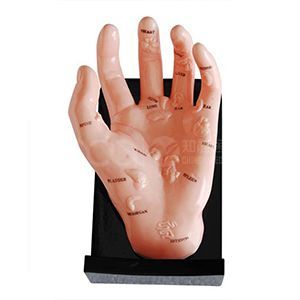
The ADA-511 is a life-size PVC hand with surface markings that correspond to traditional reflex zones — the palmar and dorsal areas that hand reflexology and acupoint teaching associate with specific organs. The markings are printed, not embossed, so the teaching value comes from the map itself: students see the zone boundaries and learn the vocabulary before they touch a patient.
Because it sits on a wooden stand, it works as a demonstration piece at the front of a classroom rather than a pass-around model. For a class of 20 that is usually the right format: one clear reference, then paired practice on each other's hands.
Anatomy teaching research consistently finds that three-dimensional physical models improve spatial understanding compared with two-dimensional images, with a meta-analysis of visualisation technologies reporting a measurable advantage for 3D approaches in anatomy education [1]. The mechanism is straightforward: a chart shows zones, a model shows zones wrapped around a three-dimensional hand, including the thenar eminence, the hypothenar border and the dorsal web spaces where zone boundaries are hardest to describe in words.
For hand points specifically, the model also fixes scale. Printed charts vary in hand size; a 20 × 12 cm model gives every student the same reference before they work on hands of different sizes.
Point systems are historical artefacts as well as anatomical ones: acupuncture charts were codified gradually over centuries, and competing mappings preceded the standardised charts used in teaching today [3]. Saying that out loud explains why the same hand zone carries different names in different curricula — and it stops students treating one printed chart as the definitive map.
What turns the map into a skill is repetition with correction, not exposure. The simulation literature is consistent that deliberate practice with specific feedback is the active ingredient in skill acquisition [2], which is why the class plan below puts six minutes of paired practice behind four minutes of demonstration.
Reflexology and acupoint mapping are traditional frameworks. The clinical evidence for organ-specific effects through hand points is limited and inconsistent, and a teaching programme that presents the map as proven mechanism invites the wrong kind of challenge from students. The defensible position is precise:
Teaching all three layers honestly produces better clinicians than teaching one layer loudly.
Q1. Is the ADA-511 a medical device? No. It is an educational model for teaching hand zones and hand anatomy.
Q2. Is the marking on one side or both? The model illustrates the main functional parts of the hand corresponding to organs; confirm palmar and dorsal coverage with the supplier before ordering.
Q3. What material is it made of? PVC, mounted on a wooden stand, sized 20 × 12 cm.
Q4. Can it be used in nursing programmes? Yes — it is commonly used in nursing and TCM teaching for hand anatomy and point location practice.
Q5. What is the minimum order quantity? MOQ is flexible and quoted per order. Email for the price list and volume tiers.
Q6. How do we request a quotation? Email adanursing@adaanatomy.com with quantity, city and the course it supports; you will receive pricing, packing data and lead time.
For the specification sheet, marking-language options and a class-size quotation: adanursing@adaanatomy.com. Production follows ISO 45001 management practice; CE documentation is available for EU procurement.