
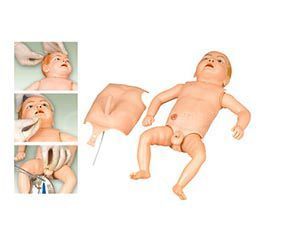
Newborn care is a set of small, fast, easily rushed actions. A student who has only read about fontanel assessment will press too hard, or not at all, on a real infant. A full-body baby manikin exists so that the first contact happens in a lab, with an instructor watching the hands.
The BIX-H140 is an advanced baby nursing manikin for paediatric and OB/GYN care training, with realistic fontanels. This article sets out a teaching sequence that uses the model properly, and the skills it cannot substitute for.
| Skill area | What the student practises | Assessment point |
|---|---|---|
| Fontanel assessment | Locating the anterior fontanel, judging tension | Hand position and pressure, not speed |
| Handling and positioning | Supporting head and neck during transfer | One-hand support under the occiput |
| Hygiene care | Cleaning, drying, skin inspection | Sequence and temperature control |
| Cord and skin observation | Recognising what is normal | Reporting language |
| Feeding support | Positioning for feeding | Head alignment and observation |
Most newborn nursing courses start with procedures — bathing, cord care, feeding — and treat assessment as theory. Reverse that order on the manikin.
The handover step is what turns a skills session into clinical preparation. A student who can assess but cannot report has not completed the task.
The anterior fontanel is a window into intracranial pressure and hydration. A sunken fontanel suggests dehydration; a tense, bulging one requires urgent review. Students cannot learn that distinction from a photograph, and they cannot practise palpation on a doll with a hard head. A manikin with realistic fontanels allows repeated, supervised palpation — which is exactly the kind of physical learning where models outperform screens and text [1].
Pair the palpation drill with a short case: "day three, feeding poorly, fontanel feels sunken". Ask what the student would check next and whom they would tell. That converts a model skill into clinical reasoning.
Simulation improves procedural skill and confidence, but the evidence is clear that it complements rather than replaces clinical exposure [2]. State this in the course outline so students do not over-trust the lab.
Quotation and specification. Current pricing, spare parts and delivery for the BIX-H140 are available from adanursing@adaanatomy.com.
Q1. What is the BIX-H140 designed for? Paediatric and OB/GYN nursing care training on a full-body baby manikin, including newborn assessment with realistic fontanels.
Q2. Does it have a soft fontanel? Yes, the manikin is specified with realistic fontanels for palpation practice.
Q3. Can it be used for bathing and hygiene training? It is a full-body nursing manikin intended for baby care training; confirm the water-resistance guidance with the supplier before immersion.
Q4. Is it suitable for medical students too? It is aimed at nursing and maternity care; medical students needing neonatal resuscitation should use a dedicated neonatal simulator.
Q5. Does it simulate crying or breathing? The model is specified for nursing care and assessment, not physiological simulation. Confirm any electronic functions with the supplier.
Q6. What should we order with it? A storage mat, spare skin or fontanel components if available, and a cleaning kit approved for the material.
Product page: Newborn Nursing Skills on the BIX-H140 Baby Manikin: A Teaching Sequence — specification, packing data and a quotation request form.
For a quotation on the BIX-H140, or to ask about spare fontanel and skin parts, write to adanursing@adaanatomy.com with your annual intake.